
The Post | Artist weaves her way to brain injury recovery
Having suffered a major cardiac arrest and a brain injury, a Manawatū artist believes her weaving work has helped her on the road to recovery.
Natasha Christensen, who took up weaving more than two years ago, has experienced some serious health issues in the past decade.
But things have been improving since she discovered her passion for weaving, and she now has an exhibition, Slow Woven, on display in Feilding.
It runs at the Feilding and District Art Society on Manchester St until the end of the month.
The pieces on show celebrate her journey and demonstrate her work with natural fibres and hand-dyed yarn in colours inspired by native plants.
Before she started having health issues, Christensen had been living in Sydney, Australia, for about 16 years.
In 2015 she started to suffer from fatigue to the point where even walking up a flight of stairs was taxing, and medical professionals couldn’t determine what the problem was.
Her mental and physical health was suffering, so she returned to New Zealand to live with her parents. Things improved until one day in 2017, at age 42, when she was in the car with her father and her niece.
“I don’t remember anything, but I’ve been told I was sitting in the back seat and said, ‘Oh, I don't feel well.’“Dad looked back in the rear-view mirror, and my head was back and my eyes were open. There was clearly something very wrong.”
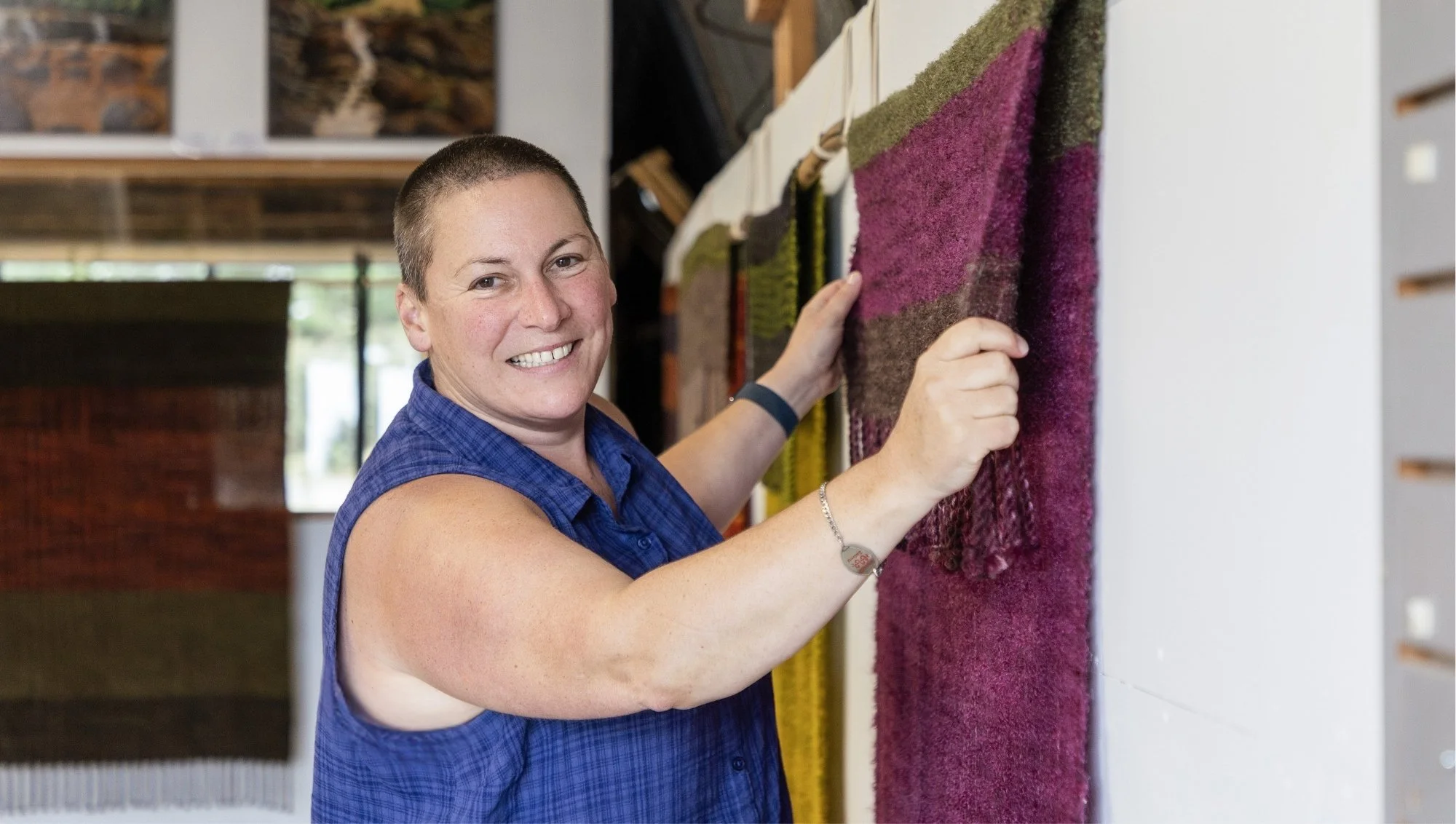
Natasha Christensen took up weaving more than two years ago and believes it has “created new pathways” in her brain after an injury. Photo credit: Adele Rycroft / Manawatū Standard
Her father performed CPR on her until an ambulance arrived and paramedics used a defibrillator to restart her heart. She remembers waking up in Wellington Hospital, having been in a coma.
She was diagnosed with hypertrophic cardiomyopathy, a heart condition that could lead to death if undiagnosed.
The lack of oxygen to her brain caused brain injury and she started “a really long, difficult road to recovery”.
Her speech was slurred and she wasn’t able to read properly. She would often walk into things and struggled with her thought process.
Because things were improving so slowly, she decided that rather than waiting to get better, she wanted to move forward with what she had.
Having studied fashion and textile design and worked as a designer and dressmaker, Christensen thought she could start sewing to make bags to sell online. She could also work at times that suited her.
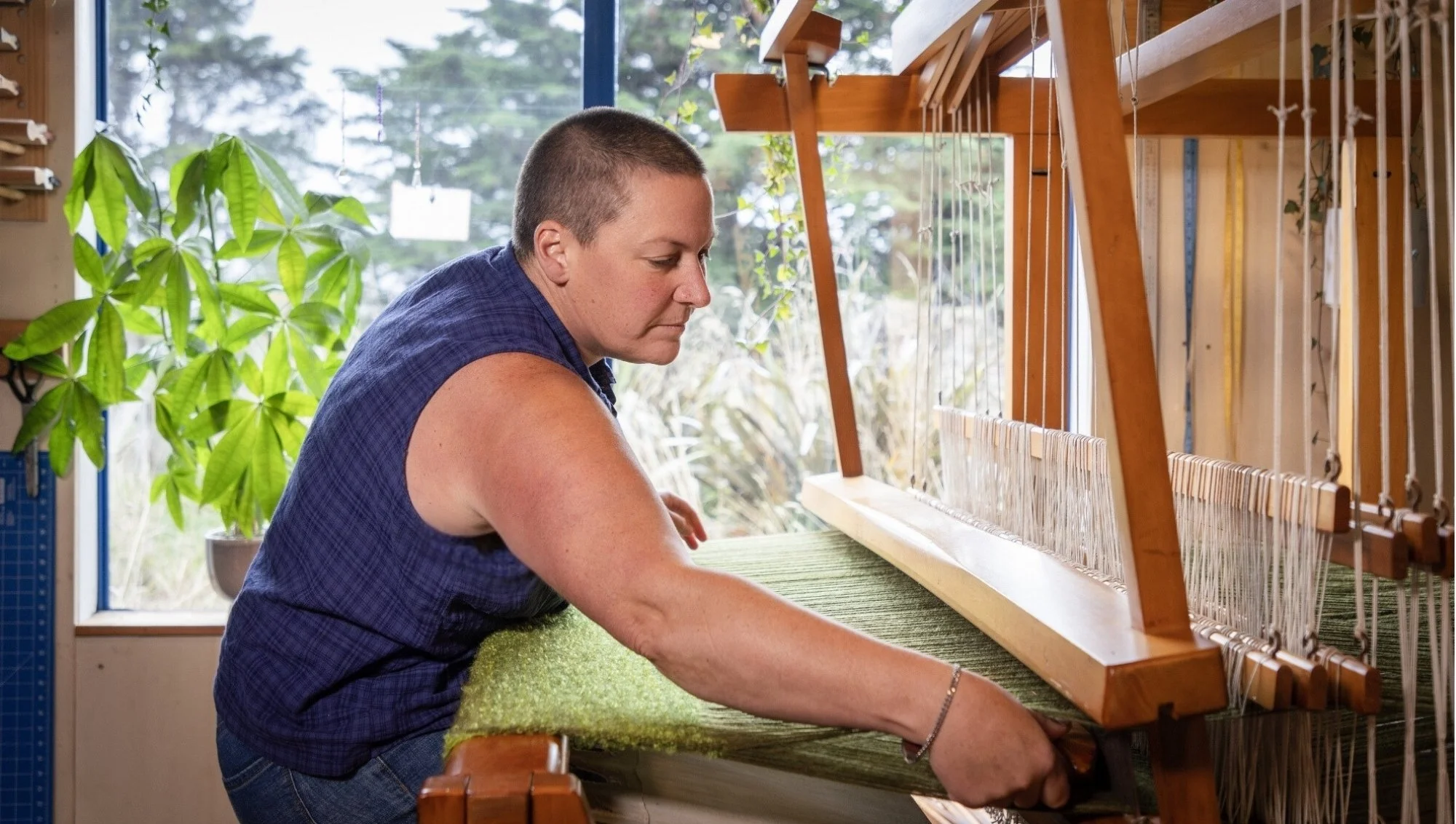
Christensen, who a background in fashion and textiles, works with natural fibres and hand-dyed yarn. Photo credit Adele Rycroft / Manawatū Standard
But when she worked she would sew the wrong pieces together no matter what she tried.
“I remember sitting there crying because it couldn’t compute.
“I knew in my brain what I was doing and I’d done it a million times before, but sometimes when I went to do it something was going wrong.”
She persisted and her skills returned. She researching organic fabrics, then got the idea of what to make when speaking to Esther Nitschke, a friend and weaver.
“Before I started weaving I was doing OK, but I was really forgetful,” Christensen said.
“I’d get very tired mentally from things and had to sleep and rest a lot.”
The repetitive method of weaving, including measuring and counting, helped her. “It was that very process that I think must have created new pathways in my brain,” she said.
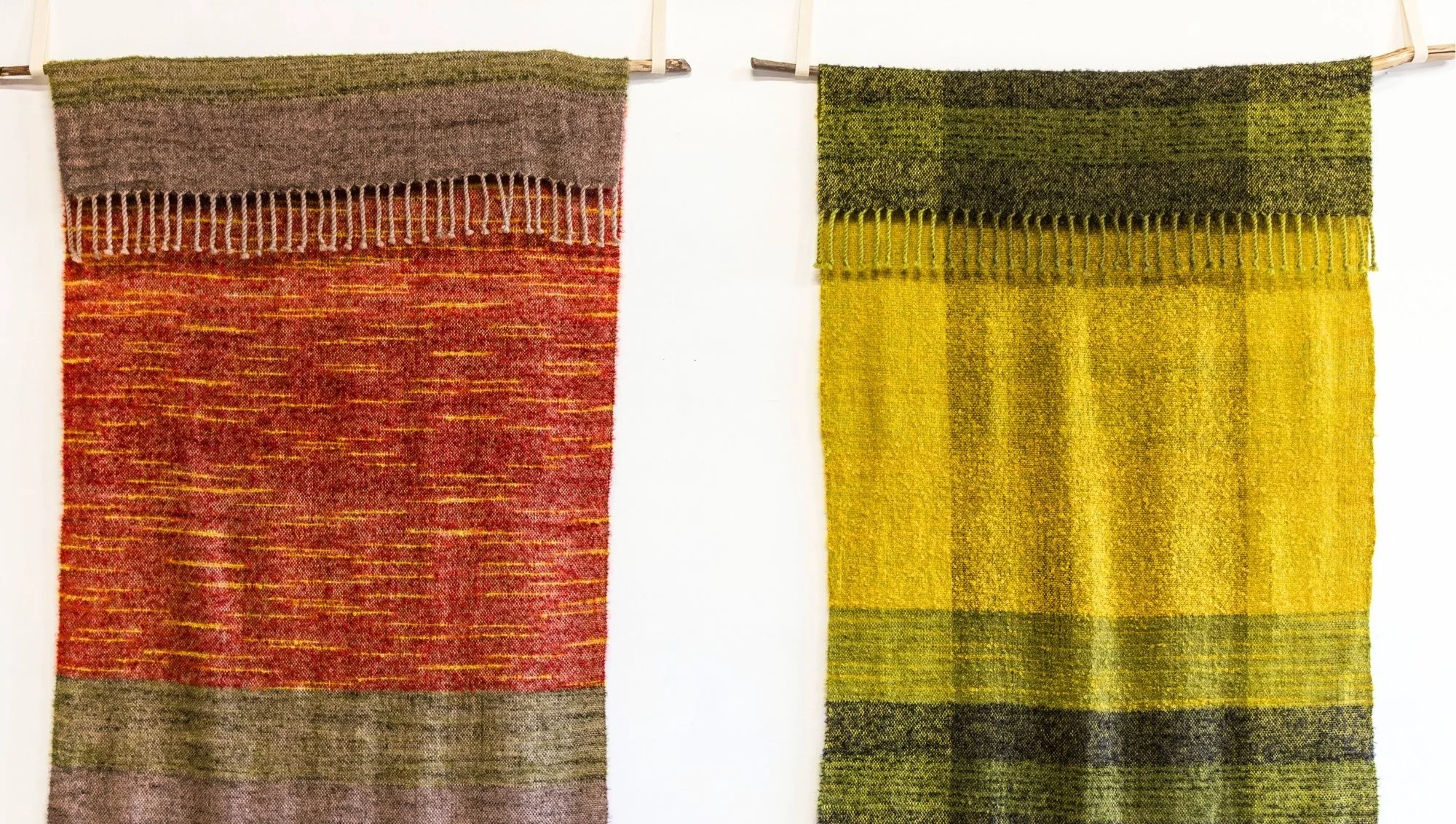
Works on display in the exhibition Slow Woven, which is on at the Feilding and District Art Society until the end of the month. Photo credit Adele Rycroft / Manawatū Standard
“My brain function has improved so much since I started weaving, even though there was the initial frustration of getting tied in knots because I started to see a result.
“Even though it was complicated and difficult at first, as I pushed through, something beautiful came off the loom.”
Even if a piece of work wasn’t perfect, she learnt from it and the next one was better.
“You think you’re going OK, then you get knocked back again. It’s just a process of being able to take a moment to pick yourself up, dust yourself off and keep going.”
She works at her own pace and can manage her workload depending on how much energy she has.
She now has a studio that she shares with her father, Graham Christensen, and also runs a small business, Slow Woven Textile Studio.
The original published story can be found on the The Post website here.